

Genome editing using the CRISPR/Cas9 system has opened up extraordinary possibilities in research and therapeutic models. Yet a key step remains the effective isolation and expansion of edited cells—especially in single-cell cloning, maintenance of viability, and downstream functional analysis. The WOLF G2® microfluidic cell sorter provides a powerful solution to this challenge through low‐pressure, high‐precision sorting designed for sensitive cell types and gene-editing workflows.
Here we highlight how three recent publications illustrate the value of gentle microfluidic sorting in CRISPR‐based workflows and show how the WOLF G2 cell sorter supports and improves these processes.
1. Niles et al., Journal of Biological Chemistry (2025) – “Bioluminescence-based assays for quantifying …”
In this study, researchers performed CRISPR editing and used single-cell sorting into 96-well plates with the WOLF Cell Sorter (with N1 Single-Cell Dispenser) to isolate edited clones effectively.
This protocol highlights how the WOLF enables reliable single‐cell deposition after editing, preserving viability and ensuring clonal outgrowth. By integrating sorting at the single-cell level, the study achieved reliable downstream functional assays (bioluminescence readouts) with minimal stress on the sorted cells.
2. Aouida et al., Scientific Reports (2025) – CRISPR knockout workflow
This publication describes a protocol for CRISPR‐Cas9–mediated knockout in human cells, including single‐cell isolation and expansion. While the primary focus is on the editing protocol, the authors emphasize that efficient isolation of single clones without undue stress is essential for maintaining integrity of edited lines.
In this context, the WOLF sorter’s gentle microfluidic sorting (<2 psi) is an ideal enabler of such workflows: it allows rapid sorting of labeled edited cells into single‐cell plates with high viability and minimal sorting‐induced artefacts.
3. Huang et al., ScienceDirect (2025) – High‐throughput functional genomics following CRISPR editing
In this more complex workflow, multiple edits and downstream functional genomics analyses necessitated sorting of edited populations with minimal perturbation. Here, gentle microfluidic sorting plays a key role in preserving cellular phenotype and transcriptional integrity, enabling robust downstream data. The article highlights the principles of the WOLF platform: low‐stress sorting, single‐cell isolation, compatibility with multi‐well plates, and high viability recovery.
Improved viability and cell health
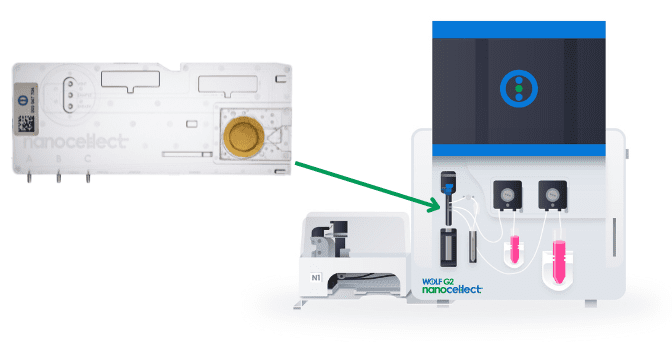
The WOLF sorter uses a disposable microfluidic cartridge and operates at under 2 psi, dramatically reducing shear stress and injury to cells during sorting. Nanocellect+1 This leads to higher post‐sort viability, fewer stress‐related artefacts (important for edited cells), and better downstream behavior (growth, differentiation, gene expression).
Single-cell deposition and improved clonality outgrowth
Isolation of single, edited cells is often required for clonal line derivation after CRISPR editing. The WOLF with its N1 Single‐Cell Dispenser enables accurate deposition into 96- or 384‐well plates, improving clone recovery and ensuring true monoclonality as demonstrated in the JBC study (Niles et al.).
Reduced time & workflow streamlining
By enabling rapid sorting of edited cells and direct plating, the WOLF can shorten the time from editing to usable clones. Traditional limiting dilution is slow and inefficient; microfluidic sorting accelerates this step, reducing the bottleneck for CRISPR workflows.
Preservation of downstream functional integrity
In functional genomics or phenotypic assays post‐editing, cell stress or sorting damage can confound results. The gentle approach of the WOLF maintains better transcriptomic, proteomic and phenotypic fidelity—crucial in the high‐complexity workflows described in the ScienceDirect article.
Compact, lab‐friendly footprint
Unlike large conventional FACS instruments, the WOLF fits on the benchtop, uses disposable cartridges (reducing contamination risk) and requires minimal maintenance. This makes it accessible for labs performing gene‐editing and clone isolation.
The recent publications underscore a clear message: for CRISPR‐based genome editing—especially when single‐cell cloning, high viability, and robust downstream assays are required—the choice of sorting method is pivotal. The WOLF microfluidic cell sorter by NanoCellect offers a compelling solution: gentle, high‐precision, user-friendly, and ideally suited to modern gene‐editing applications. Labs that integrate such gentle sorting into their CRISPR workflows are better positioned to generate high-quality edited lines, reduce bottlenecks, and improve experimental reproducibility.


